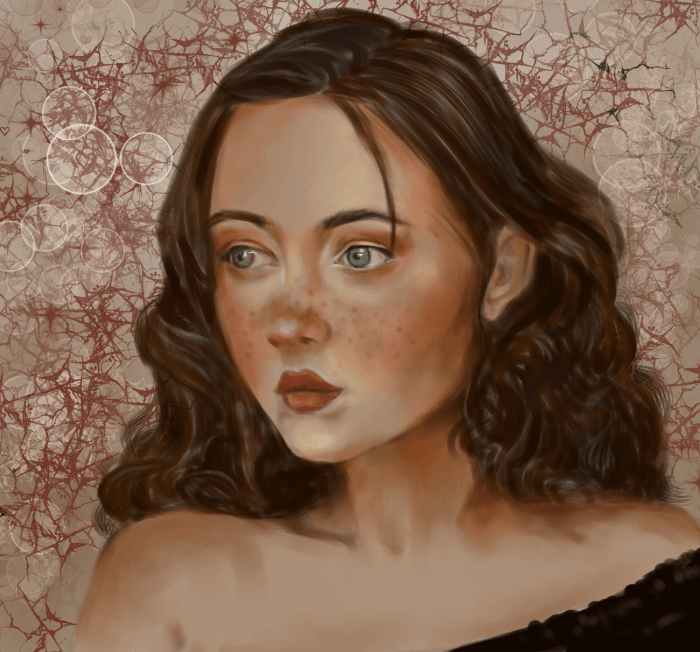
Freckled Girl, digital, photo reference from Pinterest
A few years ago, as I mentioned in my last entry, I purchased a tablet on which I can draw. For my birthday, this year I received a larger Huion display drawing tablet.
Because I do visual art, and write, it occurred to me to consider painting book covers. I’ve come to realize that many illustrators are amazing artists. They know things we didn’t learn in fine art school. Above, you see some of my illustration attempts. Many of these pieces lean heavily on the work of other artists. Most are at least modified by my ineptitude.
Like many creatives, I set up way to many learning projects each year. Learning to be an illustrater didn’t get as much time as it needed, but hey, my learning time isn’t over.
One of the hardest things in the making of art is judging improvement in your skills. We talk about the necessary 10,000 hours of practice that make you good at something. We think about that and decide maybe it isn’t 10,000 hours of practice that is needed, but instead, you need 10,000 hours of deliberate practice to make you a master.
I’m old. I’ve had tens of thousands of hours of practice in all manner of things, and I don’t think I’m a master of anything. There are things other than practice that make you a better artist. An intimate familiarity with the things of music are a necessary tool but that knowledge alone doesn’t make art. What is necessary is an openness to experience, and an understanding that experience in one domain has an echo in another. That somehow, curiously, everything is fractal and this is that. This is a hard thing to practice.
So how do you judge? Sometimes you know you’ve reached a point of excellence by the reactions of others in your creative domain. Sometimes you know because one day you find that you, yourself, know that this thing you made is good. And sometimes you have no clue at all. You just keep doing it because there is something more to be said and something more to be proven, or understood.
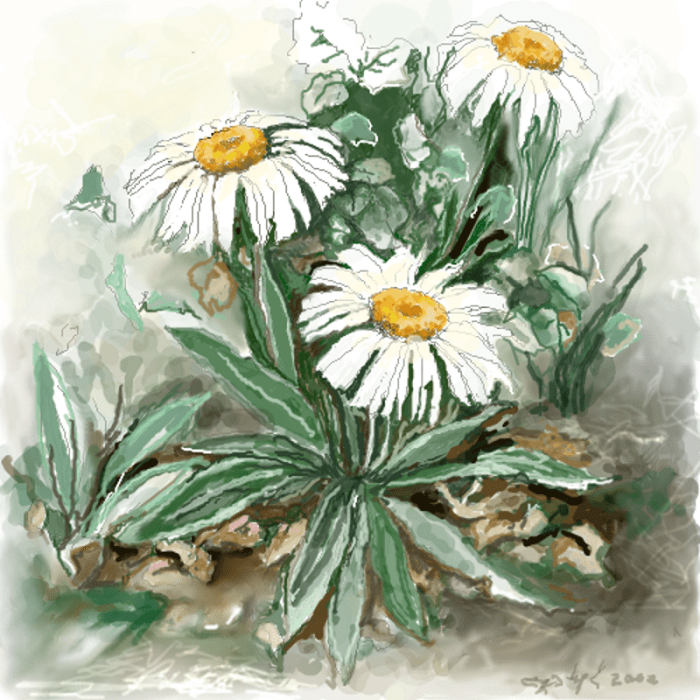
My son enables my passion for new technologys. In 2001 he gave me a Wacom Graphire II. One of Wacom’s tiny digital drawing tablets. With the use of the included pen and a software that supported the hardware, you could make a painting direct to digital.
I made the painting above with this little Wacom tablet, in a software called GIMP. (I was all about Linux in 2001, and still have one Linux only computer). The lines are wobbly, but, art-wise, this painting is no worse than many I make today. In this case, I have no clue as to whether I’ve improved, so I’ll keep on keeping on until I do. Hmmm, how did I get that watercolour like look…
As a creative person I find I have two major modes: the inner mode, which is the one that rummages around in my mind looking for patterns and divergences. And the outer mode that engages in the world and socializes with other people.
For me those two ways are very distinct. When I’m in a creative groove I’m inner focused, sometimes to an extreme. I do not want to be disturbed by disturbing things, like the wrong kind of news, the wrong kinds of sounds, the wrong kinds of light and people.
But, soon enough something curious happens. Idea generation begins to stagnate, and boredom and self-doubt set in.
It is at this point that being social, meeting with people, and being outwardly focused is the thing I need. Now, as an introvert, I find it difficult to breach that ‘being social’ barrier. I go kicking and screaming into socializing. When I, finally, capitulate I have a wonderful time. I forget all about creating things. I don’t have solutions to a paintings in my head. I don’t connive ways for my story characters to find their way out of a difficult situation. In fact, I don’t think I could do those things if I tried. It takes me days after a social period to get back into my head, and into a creative mind-space. I make tentative attempts. Again I doubt myself. But little by little, I move back into that inward space, and lo! All those things I experienced during a social time well up and become energy for something new. And the cycle begins again.
We all need social connections and community. Some of us need more than others, but everyone needs at least a little and if you do creative work you’ll do well to remember that you need it more than most. Think about it. Without input there can be no real output.
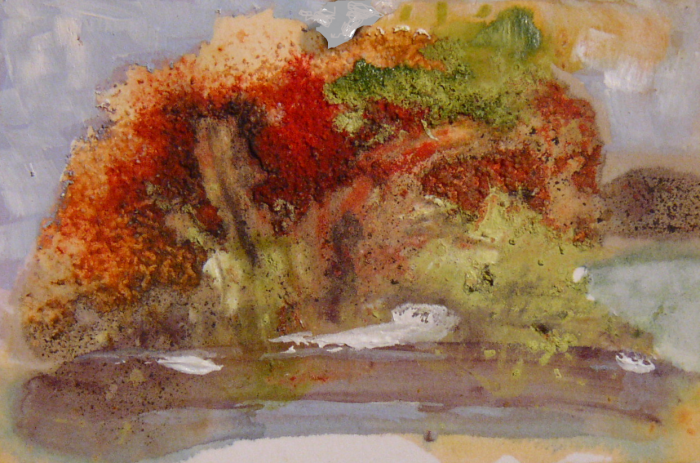
Red Trees, c1990s, gouache and wallpaper paste on paper
“The dog days or dog days of summer are the hot, sultry days of summer. They were historically the period following the helical rising of the star system Sirius, which Greek and Roman astrology connected with heat, drought, sudden thunderstorms, lethargy, fever, mad dogs, and bad luck.” —Wikipedia
Wow, that describes my condition perfectly: lethargy and erruptions of irritation. Occassionally an idea will seek me out and I’m in a fever until the lethargy comes back in taking with it every bit of energy and leaving me, dare I say, mad.
I am overstating things, but yes, there is too much smoke in the air, it’s hot, I need a new project. My old projects, though not finished fill me with lethargy. This happens.
Funny thing is it is exactly these hot, grasshopper hopping, cricket-singing days I remember from my childhood with nostalgia and longing. It occurs to me that perhaps I need not produce every minute of every day. Maybe it’s good enough, sometimes in the dog days, to lie back on a lawn chair with a good book, and look up every once in a while to watch the birds practise their flying and see the heat shimmer in the distance.
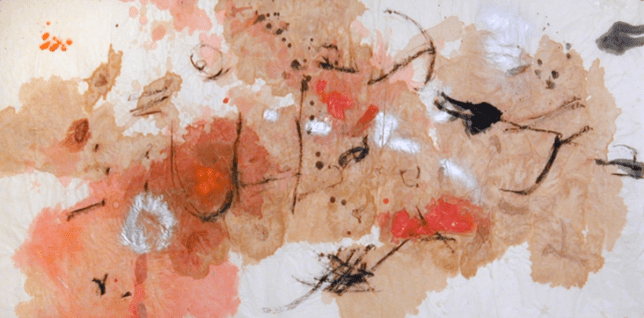
It’s Written, c 1990s acrylic on rice paper (30 x 48″)
When I studied Fine Arts at the University of Saskatchewan we made a sharp distinction between ‘fine art’ and what was often termed as ‘Sunday painting’. This university was very influence by abstract expressonism, especially the works that came out of New York in the 40s and 50s. A Prairie province, like Saskatchewan, coming late to the dominion of Canada (1905) and always tending to feel a little backward, embraced New York and it’s ideas with with a fervor we didn’t give Canadian artists.
The university had an off campus college at a northern lake (Emma Lake) and people like Stanley Boxer, Clement Greenberg and Barnet Newman (and many more) were invited to teach. I drank it all in.
As a young sprout I wanted desperately make good art. But I had no idea about this kind of painting at all. What I wanted to do was make drawings and paintings like Rembrandt. But I learned. Iit was exciting to hear the theories of these men of (yeah, mostly men, but my painting above was influenced by Helen Frankenthaler) were exciting and nicely laced with high spiritual thought. Little by little I developed what Mr. Greenberg would have called taste.
And, though not intentionally, I began to looked down on those who could draw realistically and render. I made massive paintings using no method that you might call traditional.
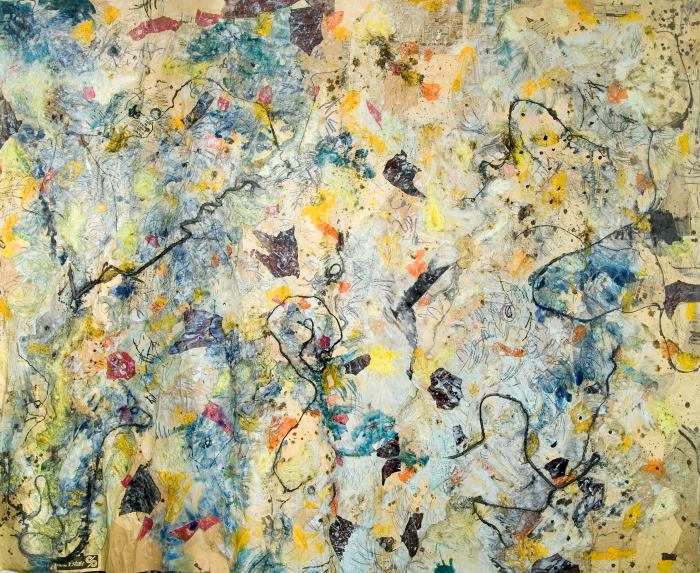
Fishing with My Father, above, was entirely built from bits of paper, glued down on a sheet of plastic, and poured over with acrylic paint washes. Then I added more bits of paper, string and whatever looked interesting, to come up with this final product. The painting is 8 feet tall by 12 feet wide.
Fast forward many years: I still like abstract expressionist art very much, but I’ve found myself yearning to draw and paint recognizable people and things. I long to render and get lost in the minutia of the subject. And guess what I’ve found. There are so very many artists, from Urban Sketchers to Illustrators who do marvellous work, that I in my ignorant pretentiousness never looked at.
So here’s a thing I’ve learned. There are all kinds of taste in art. In fact because I’m a painter, I’m now pretty much a dinosaur because current tastes are for video art, sound art, and compilations of ideas that have nothing to do with the kind of esthetic taste I was taught to cultivate.
So, here’s some advice, younguns, listen to many teachers, stay humble and learn from everyone. Here’s to staying open!
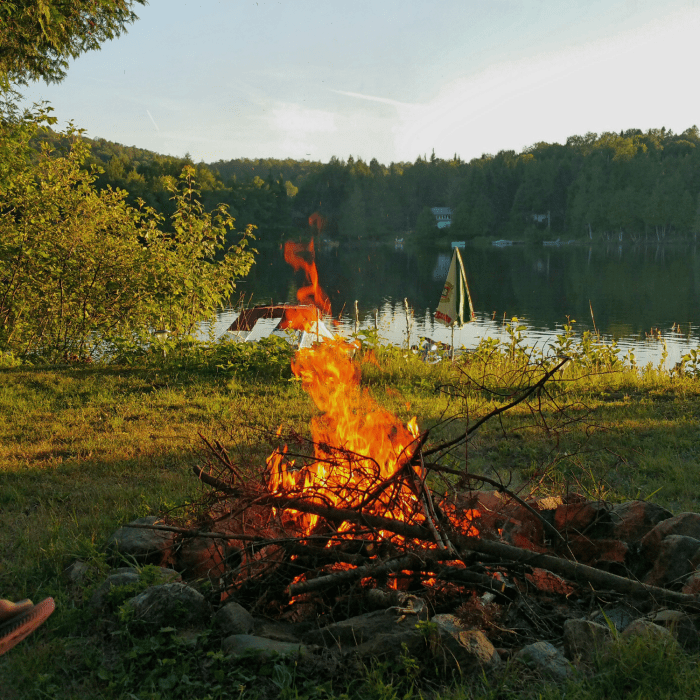
Lac Green Nord in the Province of Quebec, Canada, is an oasis. And doesn’t this fire look relaxing?
The only thing is that I’m not very good at relaxing, and to be honest when you are the playmate of a five-year-old granddaughter you don’t relax much. Little Maya who wakes up at 6:00 am told me earnestly on the evening the day after we arrived, that it would be a very good thing if I woke up earlier like she did.
Yes, Milady.
But sometimes it’s not about relaxation. It’s more about changing the input. If you keep feeding yourself the same mental diet day after day your creativity starves from lack of proper nourishment. Because I’m a head person (someone who lives more in thought than in the physical world), it is a good thing to change things up and try a sensory diet for a while. On this holiday I had every opportunity to add experiences to my mental diet. I plunged into the water, screamed when I was splashed, slapped Horseflies, whirled on a tube being towed by a boat. I went to a parade and visited family in a care home. I did no writing, not even my morning pages, and very little drawing.
At home now I have so many ideas and plans that I have to calm myself down and take a step back. I know from experience that in this stage of the creative process I will not be happy with anything I do, and everything will go too slow, and soon enough I’ll despair.
Therefore, I will pick the peas and shell them. I’ll write this blog. I’ll make a little careless drawing, and I’ll read the next chapter in The Chronos Project, (my time travel novel) and consider how I can improve it. I’ll go slow.
Give yourself the grace of going slow at times. And you don’t have to be brilliant all the time either (she said, though she finds this hard advice to take).
Oh, and I did make these two scribbles, because, hey, creativity is like a drug. It’s not easy to stop and thankfully stopping isn’t necessary.
Freckled Girl, digital, photo reference from Pinterest
A few weeks ago I wailed about not being able to paint. I’m not going to tell you that it’s all come back to me and I’m flying. But I am painting, and I’ve been completely immersed in it all week long. Everything is different, the medium, the style, the type of painting, but I’m learning, and I’m old enough to know that learning is one of life’s most important things for me. If I’m not learning, I lose interest and everything is washed over in blues.
Above is a digital piece worked in a painterly realistic style.
My whole art education was about abstraction with elements of either the sublime and/or expressionistic. I feel like a traitor to my education, and my mentors, but man, there’s a whole other world of art out there.
There was a period of time in my art life that I worked almost exclusively in collage. In the early stages it was partly because I couldn’t afford a lot of art materials, and partly because I was having trouble with acrylic on canvas, which is what everyone else was using. Of course that isn’t what I told people. I told them I was doing the ecologically decent thing, and recycling.
The early collages were built entirely of bits of paper and pours of diluted acrylic paint, ink and whatever other medium came to hand. I would stick the bits of paper–newspaper, flyers, phonebook–onto a sheet of polyvinyl, and when the painting was dry, I peeled it away, creating a work that was one piece without a backing. Some of these works were very large–8′ x 12′. The problem was how to display them. As time went by I used canvas as a backing, allowing me to stretch the work on a stretcher.
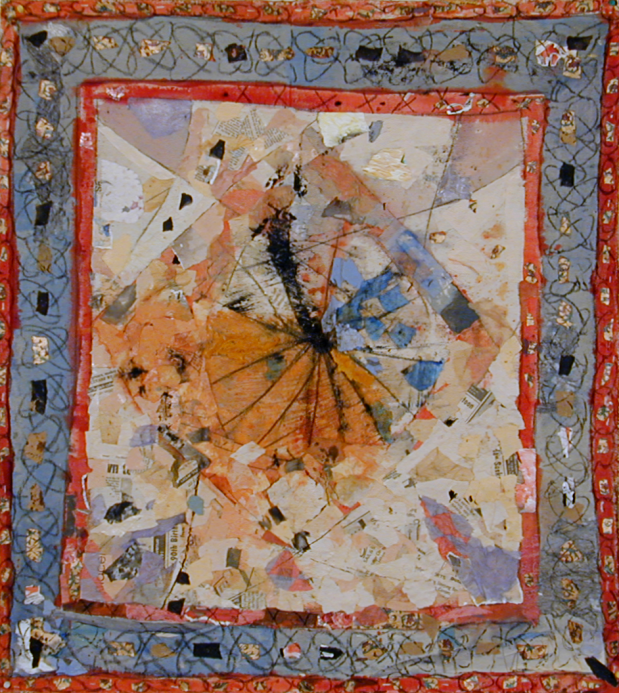
Magic Carpet is approximately 3′ x 3.5′ and has a canvas backing. Funny how I like it so much better now than I did when I created it.
After years of creating art, usually with my head bent over a panel placed on a table or on the floor, I have succumbed to serious neck and shoulder pain.
As mentioned in my last post, I’m not painting in the traditional way right now, though what I was doing wasn’t exactly traditional either.
For years I’ve worked in encaustic. Encaustic is a mixture of beeswax, damar resin and pigment, which is heated and applied in various methods on a panel. I preferred to use regular bristle brushes to apply my wax, but because it solidifies very quickly I found that the best way for me to work was to have my panel flat on a table. A slight angle was fine too, but a vertical panel didn’t work well.
Hence, my 7 pound head was hanging over a table at a degree that made it feel more like 35 pounds and hey, I’ve got one of those nerdy, long, skinny necks, which means I was creating a lot of trouble for myself.
Now, I’m mostly working digitally and I’ve been striving to find a way to keep my posture neutral. No slumping shoulders, no out-stretched neck, no reaching arm and bent wrist.
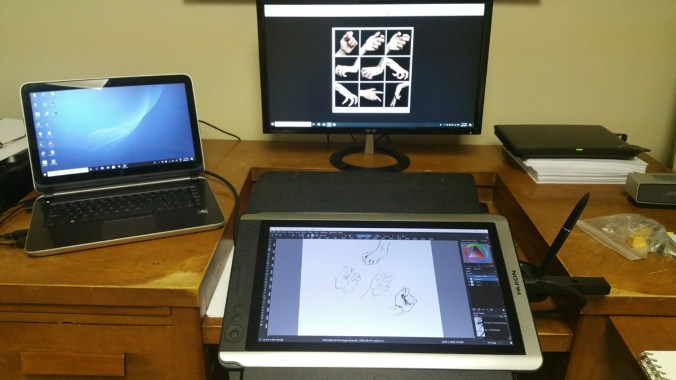
To that end I modified a small computer table I bought at Staples. In the picture above you see it as it would be if I use it for my drawing tablet, but I took off the side panel (where the mouse would normall go) so that I could put a drawing board in this same table and use it for analog drawing too. This little table-top tilts to a 45 degree angle, and because the whole thing is small and on wheels I can easily move it out of my way when I need to use my computer for writing.
It’s early days, but I think this might do the trick. Now if I could just figure out how to get the lighting right.
In the mean time, as you can see, I’ve decided to practice. I may not have anything to say in paint right now, but drawing for me is meditative, so for now, I’m doing the equivalent of scales: drawing hands, feet, gestures, contours, and so on.
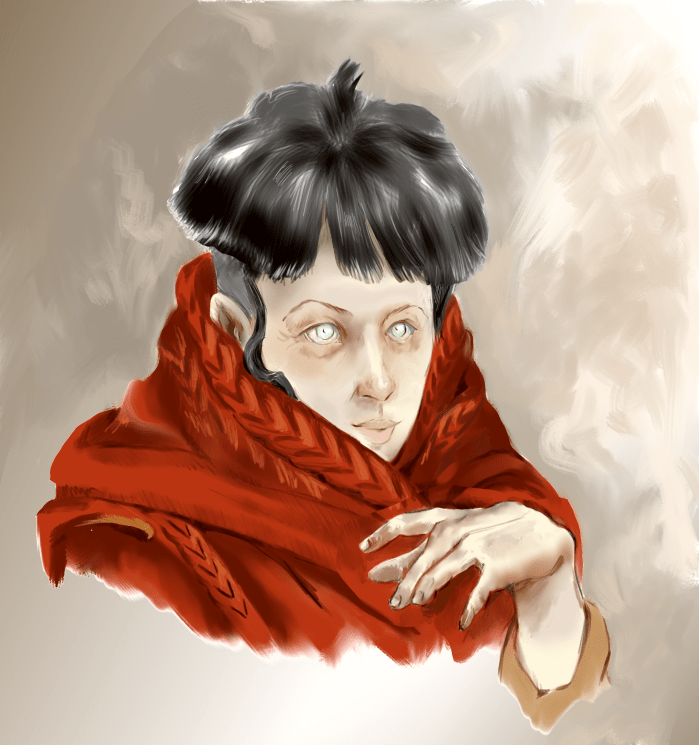
Oh and I made this very strange lady. I stole some bits of her from a drawing by Wylie Beckert.
As I mentioned a few posts ago, I have a partial manuscript I call The Chronos Project that I plan to revise.
The story is about Anna Wassar, a young ethics enforcer who works at a time-shifting facility, where historians of all sort shift to other time periods to do research in their particular field of interest.
Anna becomes aware that someone is bringing treasures from the past into the future, and that if she doesn’t stop them, the Temporal Ethics Commission will shut down the Chronos Project.
Anna shifts to 1940s Germany in pursuit of her suspect, and things do not go well.
Okay, not a bad premise. Maybe a bit Timecop, but the theme is different and I like it.
A number of years have past since I wrote the first version. Hey, I even tried a second version, and one hundred and twenty thousand words into it I still couldn’t make it work. Time has passed and I am ready to give it another try.
I printed the whole thing and began to read it back to front. To my surprised I have many excellent scenes, and surely I can…but Anna, Anna doesn’t have enough agency, and what about the murder bus and the children at Görden at Brandenburg an der Havel? How am I going to make that all fit?
Never mind. I’ll be systematic. I will separate the story into point of view sections (there are five–OMG, way to many?) and then I will read each section and see if I have a decent character arc for that character and we’ll go from there. Right. That’s a plan.
Days pass and I don’t work. “Nope, will not,” says that recalcitrant brat in my head. “Can’t, can’t, can’t. Won’t! You know what? I don’t really like writing. I don’t want to write, anymore. Heck, I’m retired. I don’t have to do hard work and I won’t. Done. I’m done.”
Except that I begin to wake up dreaming writing. Yes, thoughts in another characters head, third person.
Then this morning in my journal:
Sunday, 3 June, 2018
(ping)
It was the third of June another sleepy, dusty, delta day
I was out choppin’ cotton and my brother was bailin’ hay*
And I’m there. Yes, in the Mississippi delta, but no, not only there, but where ever the work is hard, where the air smells of fresh-mown hay, where dust lifts off a roadway and hangs in the air, where heat shimmers in the distance of—my daddy’s farm. I’m home.
(ping)
In an instant I remember others who catch me like that. Stephen King is one. Always, his words make me feel as though I’ve lived them myself. I’m two-hundred and eighty pound, gay Julianne Vernon, in my pickup truck, horse trailer behind, driving down a quiet highway. In the distance I see a car stopped on the roadside, and I know what to do. I’ll stop and lend a hand. It’s what I do, what I’ve always done. It will be my undoing, but I don’t know it yet.
Synchronicity
I look over my Facebook feed and I see a post by a printing company. It’s a link to a blog post by Meribeth Deen. Meribeth talks about writing mentors and how we all need one, and maybe if we copy their words they’ll bring us to our words, and—ding, ding, ding.
I know what to do: Read Stephen King’s words, write Stephen’s words, and then write Anna Wassar, just a little, not much, not a great long thesis, just as much as I can see in a one inch frame.
That’s how it works, creativity. One small thing leads to another thing, and still another and these things spiral and gather, swarm, swoop and excite and suddenly you can’t wait to write, to paint, to dance your dance and sing your song.
*In 1967 Bobby Gentry wrote and performed Ode to Billy Joe and I loved that song. Bobby sang it beautifully, but what I loved most was the story. A whole and complete story in the lyrics of a 4 minutes song (it was longer in the original writing). It had everything necessary for story, including a mystery. What were Billy Joe and that girl throwing off the Tallahatchie Bridge?





 Eve Barbeau