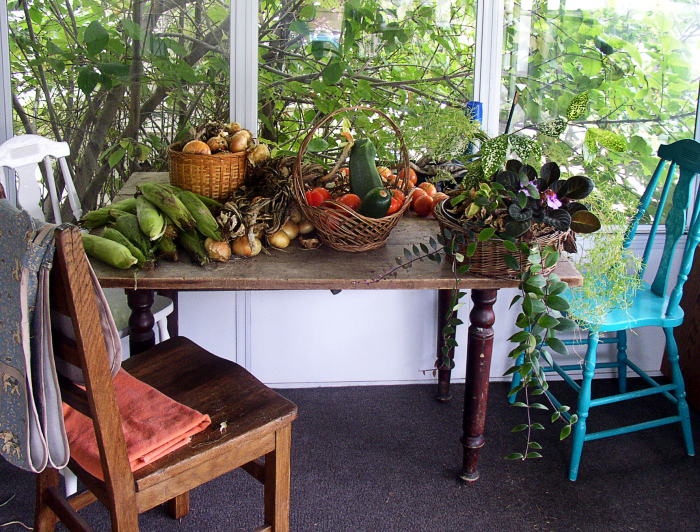
Above you see a harvest from my garden. I took this photo in the first few years we lived here.
It’s a holiday here in Canada, and though my weeks aren’t straitlaced by a nine-to-five job, I have decided to take the day off. Today is a fill up on gratitude day–oh, and turkey, and roasted vegetables, and pumpkin pie, and…
At six this morning, I was lying in bed wondering what ink drawing I could make to illustrate #1 on the Inktober calendar: Poisonous. In a couple of drowse cycles I had it. I’d draw a tarantula. Right, and baby sitting next to a tarantula, and the baby is holding a baby bottle with a skull and cross bones on it.
And that is how too many projects are born.
Inktober, now in its 9th year, was a projected dreamt up by artist Jake Paker. The idea is to make an illustration that tells a story for prompt-word assigned to each day in October. It’s fun. Many artist do this each year. You make your drawing and post it to social media. I love social media in October. (And no, I don’t love it all the time.)
After giving it further thought, I’ve decided not to do Inktober this year. I really should, it would be such good practice for my visual storytelling, but the proliferation of projects can derail progress in your creative work like nothing else. I currently have 5+ things that I am serious about and want to complete. I am fortunate not to have to fit in a day job, but even without it, 5 things, and a family leaves something short-changed all the time. You never reach a momentum on anything.
Believe it or not, I didn’t realize that I was doing this project pile-up thing. I didn’t realize it until I read Jessica Abel’sGrowing Gills early this year. Jessica’s book is about finding creative focus in your life. One of her best pieces of advice is to lose all those projects you collect and that drive you crazy with their demands. Focus on one project at a time. ONE. One ’til done.
That seems impossible to me. I write fiction and make visual art. So at the very least I always have two creative projects going. Add family life, and life in general, and I’m plenty busy.
However, if you find yourself with an itch to draw and your projects are finished, sign up for Inktober. I’m looking forward to seeing your work on social media.
P.S. Jake Parker, Lee White and Will Terry host a podcast called 3 Point Perspective. Listen, you’ll learn a lot about the business and art of illustration.
I read books on creativity all the time. I’m not sure if it’s because I, somehow, want to be assured that I’m creative, or whether I want to understand what goes on in that process. Either way, one thing that comes up time and again, is the admonition not to rely on inspiration. In fact talent and inspiration are two terms that almost everyone disses.
I understand it to an extent. Talents aren’t share equally among everyone, and we don’t want to make anyone feel bad because they were born with a little less of a particular talent than someone else. And there is in the creative community this idea that the talented rely only on their talent and don’t work hard. That’s wrong I think, but I’m going to leave that for another time.
Another thing that books on creativity disparage is inspiration. I’m not saying you should sit on your duff and wait for inspiration before you attempt your creative project, but for heaven sakes if it comes along grab it with both hands and enjoy the blessing.
In my last post I noted that I’d finally painted something I didn’t hate. I made a tiny beginning. Then a day later I had the opportunity to visit Lorenzo Dupuis’s studio. What a wonder! I still feel all melty inside when I think about his luminous work, and I was/am inspired. For months and months I’ve been feeling as though I’m repeating myself or taken what wasn’t mine from others. Now, there is a path, a way to learn, a voice to find and I’m going to follow that inspiration. And surprise, surprise there are hints that I’ve been moving in this direction for some time. Yes, I’m worried that my work will look too much like Lorenzo’s, and guess what, he worries that his work looks too much like someone else’s. Creativity is a funny circular thing. Accept your talent, your inspirations and make something of it!
It’s almost too soon to write about it, and too soon to show these tiny paintings to you, but I’m taking a chance.
Some time ago I wrote, on this blog, that I was unable to paint. I’d been working in encaustic for years, and everything I did felt like a rehash of something I’d done before, or a poor imitation of something someone else had done. The downward spiral began after my last exhibition, which was a number of years ago. I pretended it wasn’t happening and I kept spinning my wheels until early this year, when I decided to stop trying to make paintings.
Instead, I made drawings, both analog and digital, and I did an occasional watercolour where drawing was more important than painting. I enjoyed this immensely, especially when I was able to set aside the pressure to be good. This pressure is something almost all creatives experience. It’s intrinsic pressure, not pressure put on you from an outside boss. We’re our own worst critic. This is a necessary thing, but it can at times be crippling.
Last week I told you that being social isn’t only a human necessity, it is important to help you see the world afresh. I’d had a week of socializing. A long time for an introvert, and I thought I’d need a week or more to get back into to doing my work, both writing and drawing.
It rained on Monday. September is a weather turning-point in Saskatchewan and it was cold. The last thing I needed was to make myself unhappy by trying to paint, but for the first time in months and months I wanted to. I pulled out a tiny panel, and some oils and painted. The next day I made another tiny painting, and so it’s begun. Already, I see where I have connected to my past work, but I’m seeing it in new light. It has possibilities. It’s like seeing a few feet of the path in the dark forest.
It’s too early to judge but I see that I will discard some of these beginnings, maybe all of them, but one…one, even in this tiny format, might be the seed of a new painting phase.
As a creative person I find I have two major modes: the inner mode, which is the one that rummages around in my mind looking for patterns and divergences. And the outer mode that engages in the world and socializes with other people.
For me those two ways are very distinct. When I’m in a creative groove I’m inner focused, sometimes to an extreme. I do not want to be disturbed by disturbing things, like the wrong kind of news, the wrong kinds of sounds, the wrong kinds of light and people.
But, soon enough something curious happens. Idea generation begins to stagnate, and boredom and self-doubt set in.
It is at this point that being social, meeting with people, and being outwardly focused is the thing I need. Now, as an introvert, I find it difficult to breach that ‘being social’ barrier. I go kicking and screaming into socializing. When I, finally, capitulate I have a wonderful time. I forget all about creating things. I don’t have solutions to a paintings in my head. I don’t connive ways for my story characters to find their way out of a difficult situation. In fact, I don’t think I could do those things if I tried. It takes me days after a social period to get back into my head, and into a creative mind-space. I make tentative attempts. Again I doubt myself. But little by little, I move back into that inward space, and lo! All those things I experienced during a social time well up and become energy for something new. And the cycle begins again.
We all need social connections and community. Some of us need more than others, but everyone needs at least a little and if you do creative work you’ll do well to remember that you need it more than most. Think about it. Without input there can be no real output.
I’m not thinking of whether you outline, write your thesis sentence first, or how you develop your characters. What I’m considering is the physical process.
It’s interesting to hear about the processes writers employ. Many get up very early in the morning before any other family members are up, and in this early morning solitude they invite their characters to play, blithely typing away as they watch. Some only write late at night. Some write in coffee shops and so on.
It is said that Thomas Wolf wrote with a pencil on paper, using the top of his refridgerator as his desktop. And yes, he was tall, and refridgerators were shorter in those days.
A number of writers, Kevin J. Anderson is one, dictate their novels into a small recorder while they hike or walk. They then use Dragon Naturally Speaking software to transcribe the spoken word to text.
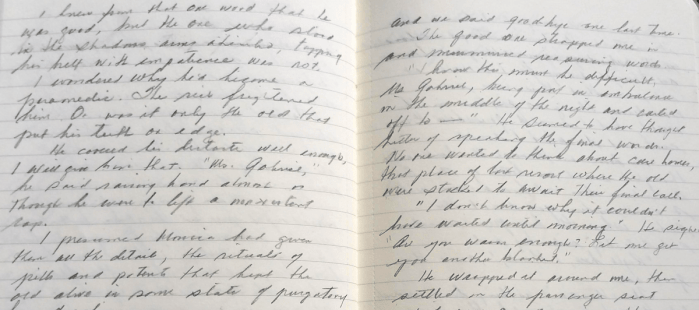
I find that I have a more intimate connection to my story if I write longhand in a lined book. And it is easier on my back to sit in a recliner and write in a notebook than on my laptop. The problem is transcribing drives me crazy. Writing with a pen or pencil isn’t the hard thing. Reading handwritten narratives, is for me the hard thing. Tougher, still if you’re trying to type what you are reading, while you’re reading.
Recently, in a Joanna Penn podcast, her mother, Jacqui Penn, also a writer, described her writing process. She writes her stories longhand in a notebook, reads it into a recorder and let’s Dragon take care of the transcription. She then edits on her computer.
This sounds brilliant to me. Her reasons for working this way, is that she finds sitting at the keyboard for long periods of time very hard on her. Yes! Me too. Sore neck, sore back, sore wrists…
I know that people write longhand less and less often. Times change. Technologies come along and do a brilliant job, but I hear that longhand writing is actually very good for you brain. (Check this, and this) And Google Docs has a facility whereby you can dictate a document on your cellphone without an intervening software like Dragon. There are plenty of issues to be sure. You have to tell dragon your punctuation marks along with the words, and Google only understand things like period and comma, but hey, what’s another learning curve! I’m going to give it a try.
Yes, it was only a week ago that I moaned a little about the heat and the smoke and the lethargy of the dog days of summer. There were hints even then that things would change. The light was different, even on days when there was no smoke. The past few days have been overcast and cold. Yesterday didn’t warm up much over eleven degrees Celsius (about 52 Fahrenheit).
The end of summer always comes as a big shock to me. It’s not like I haven’t lived in this province for nearing seventy years, and yet, each time when the potato plants die, the ferns go yellow and the weather goes cold, it’s a big surprise to me. And it never fails that it’s cold and rainy when school starts.
For all that I love September. I get excited about buckling down and finishing projects that I’ve been working on in a lackadaisical manner during the summer. So today, right after my walk I got to work on the revision of The Chronos Project. And this afternoon I’m going to finish a drawing and start another.
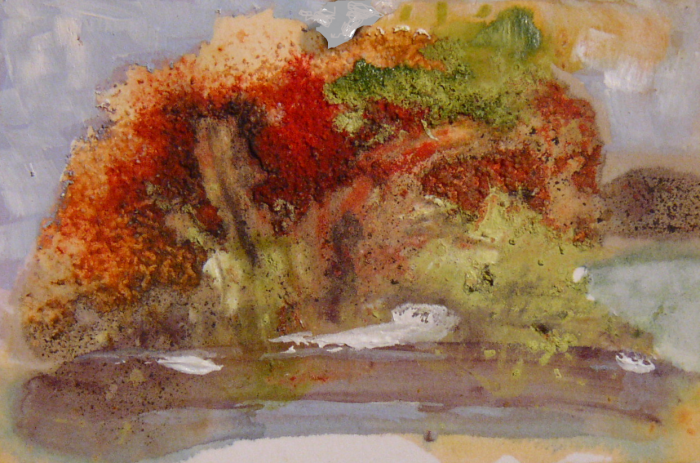
Red Trees, c1990s, gouache and wallpaper paste on paper
“The dog days or dog days of summer are the hot, sultry days of summer. They were historically the period following the helical rising of the star system Sirius, which Greek and Roman astrology connected with heat, drought, sudden thunderstorms, lethargy, fever, mad dogs, and bad luck.” —Wikipedia
Wow, that describes my condition perfectly: lethargy and erruptions of irritation. Occassionally an idea will seek me out and I’m in a fever until the lethargy comes back in taking with it every bit of energy and leaving me, dare I say, mad.
I am overstating things, but yes, there is too much smoke in the air, it’s hot, I need a new project. My old projects, though not finished fill me with lethargy. This happens.
Funny thing is it is exactly these hot, grasshopper hopping, cricket-singing days I remember from my childhood with nostalgia and longing. It occurs to me that perhaps I need not produce every minute of every day. Maybe it’s good enough, sometimes in the dog days, to lie back on a lawn chair with a good book, and look up every once in a while to watch the birds practise their flying and see the heat shimmer in the distance.
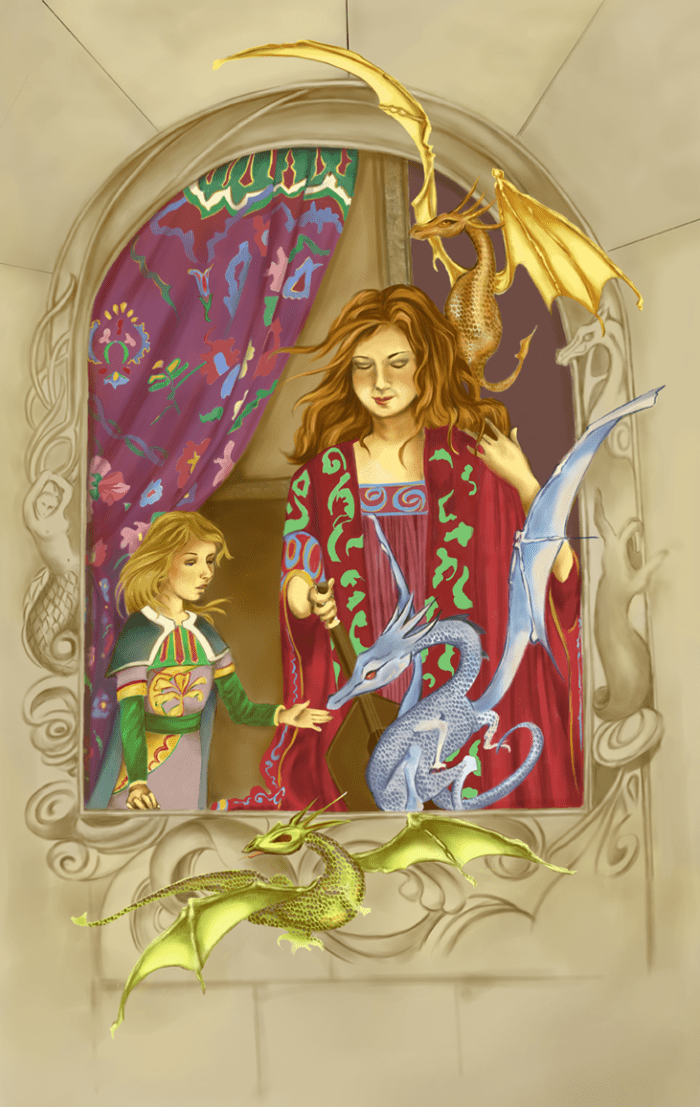
I discovered Anne McCaffrey late, but when I did I loved her Dragon Riders of Pern novels.
I created this image for one of my granddaughters, who has a birthday coming up. Shh, don’t tell her. We’re both dragon fans and I am turning this into a birthday card for her.
This is fanart. A not faithful copy of a 1980s Bantam Book Cover for Dragonsinger. The original painting was created by Elizabeth Malczynski in 1978.
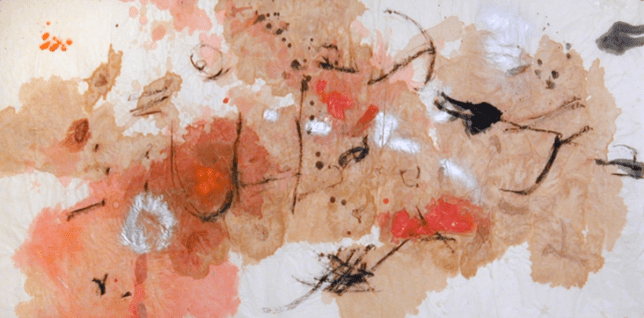
It’s Written, c 1990s acrylic on rice paper (30 x 48″)
When I studied Fine Arts at the University of Saskatchewan we made a sharp distinction between ‘fine art’ and what was often termed as ‘Sunday painting’. This university was very influence by abstract expressonism, especially the works that came out of New York in the 40s and 50s. A Prairie province, like Saskatchewan, coming late to the dominion of Canada (1905) and always tending to feel a little backward, embraced New York and it’s ideas with with a fervor we didn’t give Canadian artists.
The university had an off campus college at a northern lake (Emma Lake) and people like Stanley Boxer, Clement Greenberg and Barnet Newman (and many more) were invited to teach. I drank it all in.
As a young sprout I wanted desperately make good art. But I had no idea about this kind of painting at all. What I wanted to do was make drawings and paintings like Rembrandt. But I learned. Iit was exciting to hear the theories of these men of (yeah, mostly men, but my painting above was influenced by Helen Frankenthaler) were exciting and nicely laced with high spiritual thought. Little by little I developed what Mr. Greenberg would have called taste.
And, though not intentionally, I began to looked down on those who could draw realistically and render. I made massive paintings using no method that you might call traditional.
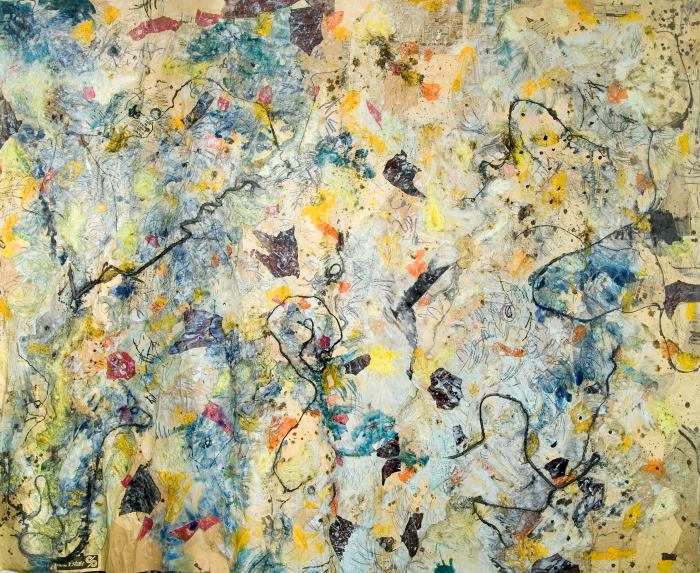
Fishing with My Father, above, was entirely built from bits of paper, glued down on a sheet of plastic, and poured over with acrylic paint washes. Then I added more bits of paper, string and whatever looked interesting, to come up with this final product. The painting is 8 feet tall by 12 feet wide.
Fast forward many years: I still like abstract expressionist art very much, but I’ve found myself yearning to draw and paint recognizable people and things. I long to render and get lost in the minutia of the subject. And guess what I’ve found. There are so very many artists, from Urban Sketchers to Illustrators who do marvellous work, that I in my ignorant pretentiousness never looked at.
So here’s a thing I’ve learned. There are all kinds of taste in art. In fact because I’m a painter, I’m now pretty much a dinosaur because current tastes are for video art, sound art, and compilations of ideas that have nothing to do with the kind of esthetic taste I was taught to cultivate.
So, here’s some advice, younguns, listen to many teachers, stay humble and learn from everyone. Here’s to staying open!


 Eve Barbeau